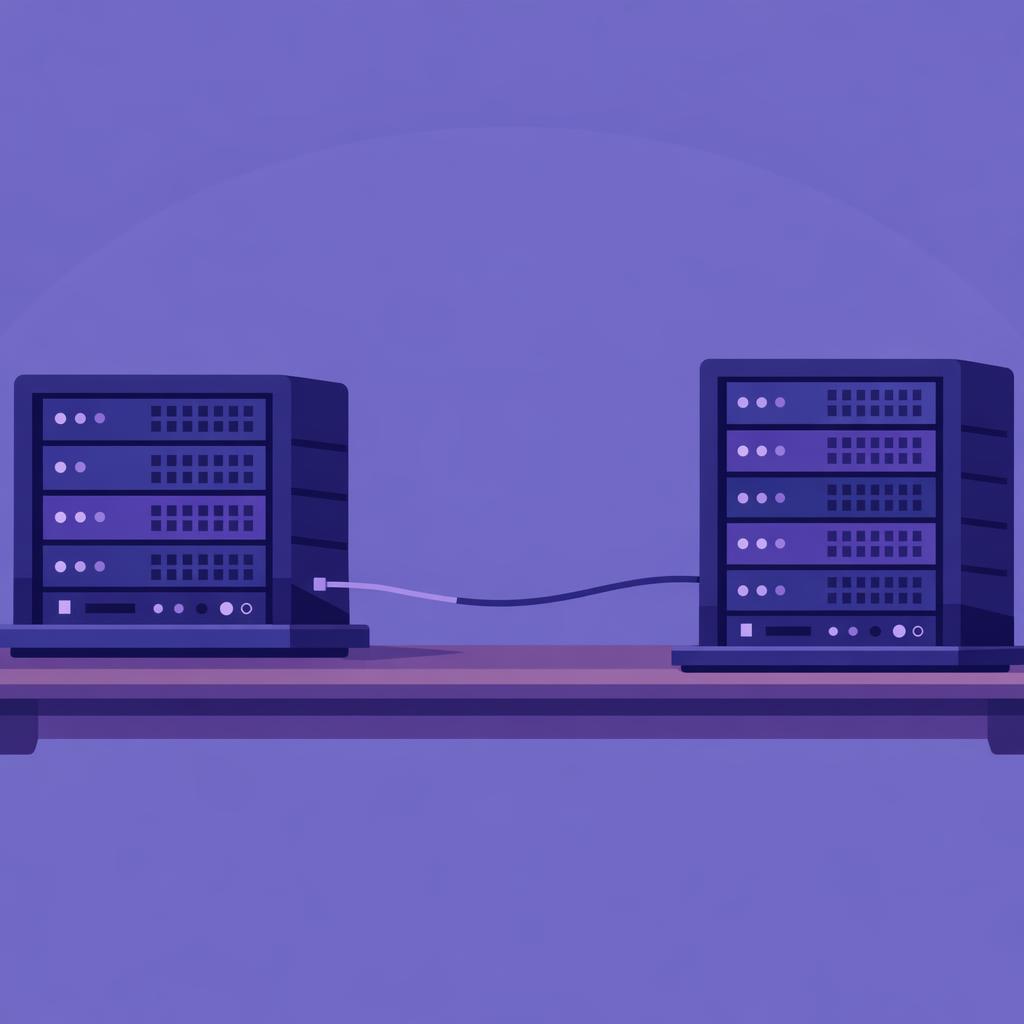
Three weeks ago I burned a full day convinced our support bot's safety classifier had regressed after what should have been a routine retrain, before I figured out what was actually going on. The shared encoder underneath it had drifted, because we'd also just folded in a big new batch of intent-classification data during the same fine-tuning run. Same backbone, two heads, one gradient update touching both. The safety head, which is supposed to catch things like self-harm language or attempts to extract a system prompt, started missing patterns it used to flag cleanly. Nobody had touched its training data. The intent head's much larger dataset had simply pulled the whole embedding space somewhere else.
I ended up splitting the two into fully separate models with a small router sitting in front of them, which fixed it, cost us some latency, and turned into the kind of decision you make once and then defend in every architecture review afterward. So a few days later, when I saw a Stanford Medicine study reporting that the human brain isn't one organ that gradually specializes but two separate organs that evolved independently and got packaged together, I read it a lot more closely than I normally would have. It's not a metaphor I'm forcing onto the situation. It turned out to be a genuinely useful way to think about a decision a lot of ML teams face and, in my experience, usually get wrong the first time.
To be clear up front: the Stanford paper is developmental biology, not machine learning, and I'm not claiming its authors said anything about neural networks. What follows is my own read on why the finding rhymes so closely with a bug I'd already lived through.
The shared-backbone trap
The original design was the standard multi-task setup you'd sketch on a whiteboard without thinking too hard about it: one transformer encoder, two linear heads on top. One head classified safety risk (self-harm, harassment, prompt injection attempts). The other classified support intent (billing, shipping, account access, and so on) so we could route the message to the right handler. Sharing the encoder felt free — one forward pass, one model to serve, and the conventional multi-task learning wisdom says shared representations generalize better across related tasks anyway.
Here's roughly what that looked like in code:
class SupportBotEncoder(nn.Module):
    def __init__(self, vocab_size, hidden_dim=512):
        super().__init__()
        self.backbone = TransformerEncoder(vocab_size, hidden_dim, num_layers=6)
        self.safety_head = nn.Linear(hidden_dim, NUM_SAFETY_CLASSES)
        self.intent_head = nn.Linear(hidden_dim, NUM_INTENT_CLASSES)

    def forward(self, input_ids, attention_mask):
        pooled = self.backbone(input_ids, attention_mask).mean(dim=1)
        return {
            "safety_logits": self.safety_head(pooled),
            "intent_logits": self.intent_head(pooled),
        }

loss = safety_loss_fn(out["safety_logits"], safety_labels) \
     + intent_loss_fn(out["intent_logits"], intent_labels)
loss.backward()
The intent dataset outnumbered the safety dataset by roughly forty to one, and it was noisier — crowd-labeled, inconsistent edge cases, the usual. Every backward pass, the intent loss dominated the gradient on the shared encoder. Phrases like "I can't do this anymore" started drifting, in embedding space, toward the same neighborhood as generic billing complaints, because the intent head had seen enough adjacent phrasing to treat it that way and the shared representation had no way to keep the two jobs' notions of "similar" separate. This is a documented phenomenon in multi-task learning — people call it negative transfer or gradient interference — but living through it in production is a different experience than reading about it in a paper.
What the Stanford study actually found
The study, led by Stanford developmental biologist Kyle Loh with graduate students Carolyn Dundes and Rayyan Jokhai as co-first authors, was published in Nature Neuroscience on September 18. For decades, the working model was that a single progenitor cell early in embryonic development gives rise to the whole brain, with regions specializing later. Loh's team found something different: the forebrain and midbrain arise from a progenitor expressing a gene called Otx2, while the hindbrain — the brain stem, which handles breathing, heartbeat, swallowing, and other functions that keep you alive without any conscious effort — arises from a separate progenitor expressing Gbx2. These two populations never overlap, from the earliest stages of gastrulation onward.
What locks them apart isn't a soft tendency, it's chromatin. The researchers found that the anterior and posterior neural ectoderm have fundamentally different chromatin packaging, meaning the genes needed to become "the other kind" of tissue are structurally inaccessible, not just unused. That explains a specific, decades-old failure: labs kept trying to coax forebrain and midbrain stem cells into becoming hindbrain neurons, and it never worked, because those cells were never capable of making that transition in the first place. Once the team understood the actual hindbrain lineage, they successfully grew functional human hindbrain motor neurons in a dish for the first time, cells that fire real action potentials and express markers for the segments controlling facial and swallowing muscles. That matters clinically because hindbrain neurons are exactly what degrade in ALS and spinal muscular atrophy, and researchers have never been able to pull that tissue from living patients to study.
"Our research suggests that evolution took two existing neural systems and pushed them together spatially." — Kyle Loh, PhD, senior author
The team also traced the same two-origin pattern back roughly 550 million years, finding it in chickens, zebrafish, and acorn worms, distant relatives that still show the same split. Jellyfish, further back still, simply have two separate nervous systems at opposite ends of their bodies that never merged into one at all.
Why shared substrates fight each other
The mechanism in the Stanford paper is chromatin accessibility: one progenitor population is structurally unable to read the genes required to become the other tissue type. Neural networks don't have chromatin, but they have an analogous constraint, which is optimization geometry. When two loss functions genuinely want to push a shared set of parameters in conflicting directions, something has to give, and it's almost never a fair fight. The task with more examples, or lower label noise, or a smoother loss landscape usually wins by default, quietly, at inference time, on exactly the inputs where the other task needed to win.
The instinctive fix, when you first see this happen, is to reweight the two loss terms or upsample the smaller task, and it's worth saying plainly that this usually doesn't work the way it looks like it works.
Once that stopped working, splitting the models outright stopped feeling like overkill and started feeling like the obvious next step.
Splitting the service, not just the model
The fix that actually held up was giving the safety classifier its own small, separately trained model with its own dataset, its own eval suite, and its own retraining cadence, then putting a lightweight router in front of both models instead of one shared encoder underneath them.
The safety model runs first, on every message, because a missed escalation is the failure mode we care about most. The intent model only runs if the message clears that first check, which also means the two models never need to agree on a shared notion of "similar" in the first place.
async def handle_message(message: str) -> Response:
    risk = await safety_model.classify(message)
    if risk.requires_escalation:
        return escalate_to_human(message, risk)

    intent = await intent_model.classify(message)
    return route_to_intent_handler(intent, message)
Nothing about this is clever. That's kind of the point. The safety model is small enough to run cheaply on CPU and gets retrained the moment new abuse patterns show up, without anyone worrying about whether that retrain will quietly move the intent classifier's decision boundary somewhere it shouldn't be. The two models don't share a single parameter, which means a bad retrain on one literally cannot leak into the other. The router adds a network hop and a bit of latency, and in exchange we got two systems whose worst-case behavior we can actually reason about independently.
The cost of running two organs
None of this is free, and it's worth being honest about what you're actually trading away. Two separately served models mean two eval pipelines, two on-call surfaces, and two places where model drift can happen independently — occasionally the safety model and the intent model disagree about what a message even means, and reconciling that disagreement is a debugging session neither model existed before.
Serving cost went up too, since two small forward passes in sequence isn't strictly cheaper than one medium forward pass, even if it's more predictable, and the latency budget for the safety check has to fit comfortably ahead of the intent classification or the whole pipeline gets slower for every single message, not just the risky ones.
If your two tasks don't have meaningfully different failure costs, or you've got plenty of clean labeled data for both, a shared backbone is still the pragmatic default. I'd rather maintain one model with a slightly muddier decision boundary than two models, two dashboards, and a router, if the thing I'm protecting against isn't actually catastrophic when it goes wrong.
What I'd actually check before splitting anything
When a teammate proposes splitting a shared model into two, the question I ask first isn't architectural, it's about consequences: what does it cost us, concretely, when this specific task fails silently versus when the other one does? If the answer is "about the same," the split probably isn't worth the operational overhead, and that engineering time is better spent elsewhere. If the answer is wildly asymmetric, like it was for us, the split usually pays for itself within the first incident it prevents.
In practice, I've narrowed it down to a handful of questions I actually walk through before recommending a split, rather than defaulting to "shared backbone" out of habit:
- Do the two tasks have meaningfully different failure costs, not just different accuracy targets?
- Do their datasets differ by an order of magnitude or more in size?
- Is one dataset noticeably noisier or less consistently labeled than the other?
- Do they need to run on different infrastructure or latency budgets in production?
- Do they get retrained on different schedules, by different teams, with different review processes?
If two or more of those are true, I stop treating the shared model as the default and start treating the split as the default instead. What stuck with me most from the Stanford paper wasn't the mechanism, it was Rayyan Jokhai's observation that these two nervous systems have been separate since long before there was anything resembling a modern brain, and yet they now function together closely enough that nobody questioned the "one brain" assumption for centuries. That's the outcome you actually want from splitting a system: not two visibly bolted-together parts, but a seam good enough that from the outside, it looks like it was always one thing. If your split system doesn't get there yet, you haven't finished the job, you've just moved the mess from the model into the router.
Comments
No comments yet — be the first to share your thoughts.